
On this page
An implementation intention is an if-then plan ("if it is 3 pm, I will check the queue"), and your AI agent can write yours as a Focus Pad task with a deadline through the Focus Pad MCP server in DevWorkspace Pro.
"I will look at the flaky test later." Most developers say a sentence like this every day. Most of those sentences do not turn into action.
The problem is not motivation. It is that "later" is not a moment. Nothing in your day tells you now is later. An implementation intention fixes that, and it is one of the best supported tools in goal research.
This guide explains what it is, gives examples for developers, and shows how an AI agent can write these plans for you.
In short
- An implementation intention says: if situation X, then I will do Y.
- Meta-analyses of hundreds of studies find real effects on reaching goals.
- Explicit if-then wording, real motivation and rehearsal make plans stronger.
- An AI agent can turn your goals into timed tasks on your screen, with reminders.
What an implementation intention is
Psychologist Peter Gollwitzer separated two kinds of intention (Gollwitzer, 1999):
| Goal intention | Implementation intention | |
|---|---|---|
| Form | "I want to reach Z" | "If X happens, then I will do Y" |
| Example | "I want to fix the flaky test" | "If I finish the PR review, then I open OrderTotalTest" |
| What starts the action | You have to remember | The situation does |
The idea is to hand control to a cue. When the cue appears, the action comes to mind without a search through memory.
What the evidence says
- 2006 meta-analysis. Across 94 independent tests, forming implementation intentions had a medium-to-large effect on goal attainment, d = .65 (Gollwitzer & Sheeran, 2006). Plans helped people start, stay on track against distractions, and let go of failing courses of action.
- 2024 meta-analysis. Across 642 tests, effects ranged from d = .27 to d = .66 across cognitive, emotional and behavioural outcomes. Effects were larger when plans had an explicit if-then format, when people were highly motivated, and when they rehearsed the plan (Sheeran, Listrom & Gollwitzer, 2024).
- Remembering to act. In a study with older adults, people who formed an implementation intention were more than twice as likely to carry out a task that needed self-initiation. It did not help on a task that already had a salient cue (Chasteen, Park & Schwarz, 2001).
The last point matters. If-then plans help most when nothing in the environment would remind you. That describes most of a developer's "later".
Plans also quiet the mind. Masicampo and Baumeister (2011) found that unfinished goals cause intrusive thoughts, and that a specific plan removed the effect.
Examples for developers
Two common kinds of if-then plan: one ties an action to a moment, the other prepares for an obstacle.
Moment plans
- If it is 10:00, then I start the migration review.
- If I merge a PR, then I write the next task's first step before I switch.
- If I open the laptop in the morning, then I read my Focus Pad list before chat.
- If I deploy to production, then I check the error rate at 16:00.
Obstacle plans
- If CI goes red, then I open the failing test before I check messages.
- If I am stuck on a bug for 30 minutes, then I write down what I know and ask for help.
- If I want to check chat in the middle of a function, then I add a note to Focus Pad and keep going.
- If a meeting runs over, then I move the timebox, not drop it.
Keep plans few and sharp. A cue you can recognise and an action you can start at once.
Where AI agents fit
Writing good if-then plans takes a minute each. Most people skip it. An AI agent can do the writing, at the moment the goal comes up.
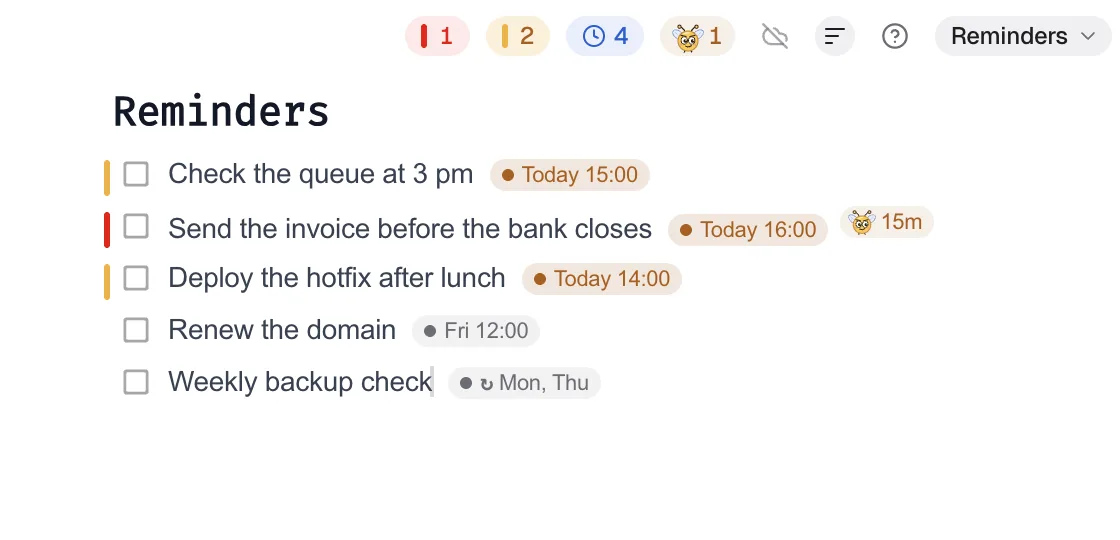
I run an agent I call the Secretary. When I tell it about a goal, it turns the goal into a task with a time cue and writes it to Focus Pad, the always-on-top checklist in DevWorkspace Pro, through the Focus Pad MCP server.
| What I say | What the agent writes |
|---|---|
| "I need to look at the flaky test" | TIMEBOX 1 h: fix flaky OrderTotalTest, due 14:00 |
| "Remind me to check prod after the deploy" | Check prod error rate, due 16:00, Pesky timed to fire at 16:00 |
| "I keep putting off the design doc" | TIMEBOX 2 h: write billing design doc, first draft, priority 5, due tomorrow 10:00 |
The call is short:
{ "name": "add_item", "arguments": {
  "collection": "Job Board",
  "text": "TIMEBOX 1 h: fix flaky OrderTotalTest",
  "priority": 4, "due": "2026-10-14T1400" } }
The agent reads my local time from list_items first, so "after lunch" becomes a real time, not a guess.
Today

Pesky
Fix checkout bug from #334
acme-shop
Call off Pesky
The cue still has to reach you
A time is only a cue if you notice it. Focus Pad helps in two ways. The deadline label turns amber when 24 hours or less are left, and red when the time has passed. For tasks that must not slip, Pesky sends a desktop notification at a set interval until you complete the task. Pesky counts from the moment it is set, so the agent sets the interval to the minutes until the cue time.
Rehearsal, for free
The 2024 meta-analysis found that rehearsed plans work better. A list that stays on top of your editor is a quiet rehearsal. You read "if 10:00, then migration review" every time you glance at it.
A five-minute routine
- At the end of the day, tell your agent what is still open.
- Ask it to write tomorrow's first three tasks as timeboxes with a start time.
- Ask it to add one obstacle plan for the task you avoid most.
- Read the list once before you close the laptop.
Related
- Close open loops: the Zeigarnik effect
- An AI secretary agent for developers
- Keep only high-priority work in view
References
- Gollwitzer, P. M. (1999). Implementation intentions: Strong effects of simple plans. American Psychologist, 54(7), 493–503. https://doi.org/10.1037/0003-066X.54.7.493
- Gollwitzer, P. M., & Sheeran, P. (2006). Implementation intentions and goal achievement: A meta-analysis of effects and processes. Advances in Experimental Social Psychology, 38, 69–119. https://doi.org/10.1016/S0065-2601(06)38002-1
- Sheeran, P., Listrom, O., & Gollwitzer, P. M. (2024). The when and how of planning: Meta-analysis of the scope and components of implementation intentions in 642 tests. European Review of Social Psychology, 36(1), 162–194. https://doi.org/10.1080/10463283.2024.2334563
- Chasteen, A. L., Park, D. C., & Schwarz, N. (2001). Implementation intentions and facilitation of prospective memory. Psychological Science, 12(6), 457–461. https://doi.org/10.1111/1467-9280.00385
- Masicampo, E. J., & Baumeister, R. F. (2011). Consider it done! Plan making can eliminate the cognitive effects of unfulfilled goals. Journal of Personality and Social Psychology, 101(4), 667–683. https://doi.org/10.1037/a0024192
FAQ
Frequently asked questions
What is an implementation intention?
A plan in the form: if situation X happens, then I will do Y. The term comes from psychologist Peter Gollwitzer. It links a specific cue to a specific action, so the action starts when the cue appears.
Do implementation intentions work?
A 2006 meta-analysis of 94 tests found a medium-to-large effect on goal attainment (d = .65). A 2024 meta-analysis of 642 tests found effects from d = .27 to d = .66 across cognitive, emotional and behavioural outcomes.
What makes an if-then plan work better?
In the 2024 meta-analysis, effects were larger when the plan used an explicit if-then format, people were highly motivated to reach the goal, and they rehearsed the plan.
What are examples for programmers?
If CI goes red, then I open the failing test before I check chat. If it is 10:00, then I start the migration review. If I am stuck on a bug for 30 minutes, then I write down what I know and ask for help.
How can an AI agent help?
It can turn a vague goal into a task with a time cue, and write it to your Focus Pad list with a deadline and a reminder, through the Focus Pad MCP server.