On this page
Prospective memory is remembering to do something at the right time, and it fails when nothing reminds you, so put the cue outside your head, for example as a Focus Pad task with a deadline in DevWorkspace Pro.
At 10:00 you tell yourself: check the queue backlog at 3pm. At 6pm you remember. Nothing went wrong with your memory of the task. You know exactly what it was. What failed was remembering at the right time.
Psychologists call this prospective memory: remembering to do things in the future. It has its own research, and it explains why the 3pm task slips, why holding it in mind costs you, and what actually helps.
In short
- Time-based tasks ("at 3pm") are harder than event-based ones ("when X happens") because nothing cues them.
- Holding an intention in mind can slow down the work you are doing.
- External reminders help. A good reminder turns a time-based task into an event-based one.
- An AI agent can set those reminders for you the moment a task comes up.
Two kinds of "remember to"
| Kind | Example | What triggers it |
|---|---|---|
| Event-based | When CI finishes, merge the PR | An event you will notice |
| Time-based | At 3pm, check the queue | Only you, by checking the clock |
In a classic study, Einstein and colleagues (1995) gave people a time-based task (do something every 10 minutes) and an event-based task (do something when a certain word appears). Age differences showed up on the time-based task, not the event-based one. Their explanation: time-based tasks depend more on self-initiated retrieval. You have to bring the intention back to mind on your own.
A developer at 3pm is deep in a stack trace. Self-initiated retrieval does not stand a chance.
Holding it in mind is not free
One fix is to keep the intention "in the back of your mind". That has a cost.
In experiments by Smith (2003), people who held an intention while doing another task were slower at that task. Those who were slower were also better at the intention. Watching for the moment uses capacity.
The multiprocess framework (McDaniel & Einstein, 2000) says remembering can come from active monitoring or from a more automatic response to a cue. Einstein and colleagues (2005) found that both happen, and that people rely on monitoring to different degrees depending on the task and the person.
For a time-based task with no cue, monitoring is often the only option. You glance at the clock, again and again, while trying to write code.
What helps: put the cue outside your head
External aids
In early lab work on prospective memory, Einstein and McDaniel (1990) found that external aids improved performance. Later research on cognitive offloading (Risko & Gilbert, 2016) describes the same move: use the world to hold what your memory would otherwise have to. In online experiments with 1,196 participants, being able to set external reminders improved performance on delayed intentions (Gilbert, 2015).
A reminder converts a time-based task into an event-based one. "At 3pm" becomes "when the notification appears". You no longer have to monitor.
A note of balance
Gilbert and colleagues (2020) found that people lean toward reminders even when unaided memory would earn more, partly because they underrate their own memory. Reminders are not always optimal. For the tasks that matter at a set time, though, they are the reliable choice.
Plans with a cue
An implementation intention ("if it is 3pm, then I check the queue") also helps. In a study with older adults, it more than doubled how often people carried out a task that needed self-initiation (Chasteen, Park & Schwarz, 2001). See implementation intentions for developers.
How I handle the 3pm task
I use Focus Pad, the always-on-top checklist in DevWorkspace Pro, with an AI agent I call the Secretary. The agent writes tasks through the Focus Pad MCP server.
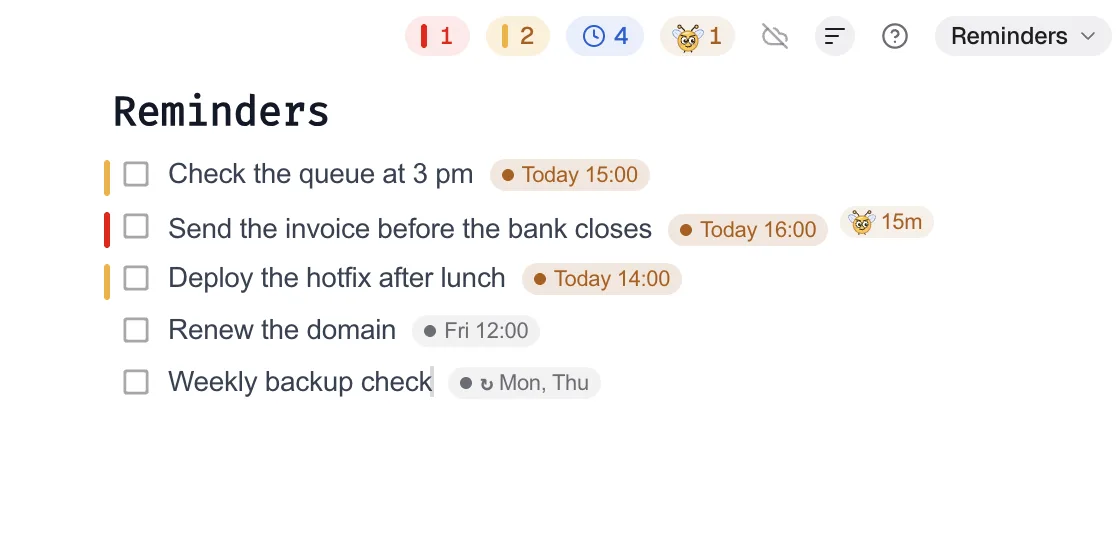
At 10:00 I say: "check the queue backlog at 3pm". The agent:
- Calls
list_itemsto read my local time (localTime), so it does not guess the time zone. - Adds the task with a deadline at 15:00 and a Pesky interval timed to that moment.
{ "name": "add_item", "arguments": {
  "collection": "Job Board",
  "text": "Check the queue backlog on prod",
  "priority": 4, "due": "2026-10-14T1500", "pesky": 300 } }
Pesky counts from the moment it is set, not from the deadline. Added at 10:00, a 300-minute interval puts the first desktop notification at 15:00. If I do not complete the task, it comes back every 300 minutes until I do. If I want closer nudges after 3pm, the agent changes the interval with update_item.
Until then, I do not monitor anything. The deadline label sits on the task, turns amber, and the notification does the rest.
Today

Pesky
Fix checkout bug from #334
acme-shop
Call off Pesky
Small rules that make it reliable
- Write the cue into the task. "Check the queue backlog on prod" is an action. "Queue" is not.
- One reminder per task that matters. Too many and you start to ignore them. See reminders that respect deep focus.
- Complete it properly. ⌘-click (Ctrl-click) completes a task and stops Pesky. A normal click only selects it.
- DevWorkspace Pro must be open. Pesky runs when the Focus Pad window is closed, but not when the app is quit.
Related
- Let your AI agent set reminders
- Pesky reminders: nagging that you control
- Close open loops: the Zeigarnik effect
- An AI secretary agent for developers
References
- Einstein, G. O., & McDaniel, M. A. (1990). Normal aging and prospective memory. Journal of Experimental Psychology: Learning, Memory, and Cognition, 16(4), 717–726. https://doi.org/10.1037/0278-7393.16.4.717
- Einstein, G. O., McDaniel, M. A., Richardson, S. L., Guynn, M. J., & Cunfer, A. R. (1995). Aging and prospective memory: Examining the influences of self-initiated retrieval processes. Journal of Experimental Psychology: Learning, Memory, and Cognition, 21(4), 996–1007. https://doi.org/10.1037/0278-7393.21.4.996
- Smith, R. E. (2003). The cost of remembering to remember in event-based prospective memory: Investigating the capacity demands of delayed intention performance. Journal of Experimental Psychology: Learning, Memory, and Cognition, 29(3), 347–361. https://doi.org/10.1037/0278-7393.29.3.347
- McDaniel, M. A., & Einstein, G. O. (2000). Strategic and automatic processes in prospective memory retrieval: A multiprocess framework. Applied Cognitive Psychology, 14(7), S127–S144. https://doi.org/10.1002/acp.775
- Einstein, G. O., McDaniel, M. A., Thomas, R., et al. (2005). Multiple processes in prospective memory retrieval: Factors determining monitoring versus spontaneous retrieval. Journal of Experimental Psychology: General, 134(3), 327–342. https://doi.org/10.1037/0096-3445.134.3.327
- Risko, E. F., & Gilbert, S. J. (2016). Cognitive offloading. Trends in Cognitive Sciences, 20(9), 676–688. https://doi.org/10.1016/j.tics.2016.07.002
- Gilbert, S. J. (2015). Strategic offloading of delayed intentions into the external environment. Quarterly Journal of Experimental Psychology, 68(5), 971–992. https://doi.org/10.1080/17470218.2014.972963
- Gilbert, S. J., Bird, A., Carpenter, J. M., Fleming, S. M., Sachdeva, C., & Tsai, P.-C. (2020). Optimal use of reminders: Metacognition, effort, and cognitive offloading. Journal of Experimental Psychology: General, 149(3), 501–517. https://doi.org/10.1037/xge0000652
- Chasteen, A. L., Park, D. C., & Schwarz, N. (2001). Implementation intentions and facilitation of prospective memory. Psychological Science, 12(6), 457–461. https://doi.org/10.1111/1467-9280.00385
FAQ
Frequently asked questions
What is prospective memory?
Remembering to do something in the future, at the right time or in the right situation. For example, checking a deploy at 3pm or replying to a colleague after a meeting.
Why are time-based tasks so easy to forget?
Nothing in the environment reminds you that it is 3pm. You must start the memory yourself, often while busy with something else. Research by Einstein and colleagues links this self-initiated retrieval to more failures.
Does holding an intention in mind cost anything?
It can. In experiments by Smith (2003), people holding an intention responded more slowly on the task they were doing. Einstein and colleagues (2005) found that people rely on monitoring to different degrees, depending on the task.
Do reminders really help?
External aids helped prospective memory in Einstein and McDaniel (1990), and external reminders improved performance in online experiments by Gilbert (2015). Gilbert and colleagues (2020) found people often prefer reminders even when unaided memory would pay more.
Is this a medical issue?
This guide is about everyday forgetting, not a diagnosis. If memory problems worry you, talk to a doctor.